Friday, March 15, 2013

Kosher Showers

Out of the woodwork they came, one by one, then in larger waves, like those ants who went marching or the teddy bears arriving at their picnic in the woods.  If you arrived a mere five minutes early, as we had done, the place was empty, tables neatly set for people that clearly weren't planning on showing up.  Show up ten minutes late, and you were fighting for a seat.  Before long, what started by feeling almost as if we were trespassing on something small and private, had turned into what must be one of the best kept secrets in town:  Shabbat in Shanghai.

Where did all the Jews come from?

Such was the first question I asked my friend Michelle upon sitting down to dinner after Shabbat services at the Shanghai Jewish Center.  We'd been talking about going to Shabbat here for a couple months now, primarily to appease Michelle's Jewish-guilt-flinging grandmother.  We weren't really sure what to expect, since neither of us know that many Jews in town.  It turns out, there are a lot, perhaps not in terms of relative numbers, but certainly in terms of cultural enthusiasm.  At least 70 people showed up to the services tonight, if not more.  Some of them live here, some of them were passing through -- all of them, however, were welcome and welcoming.

Like the telltale smell of grandma's matzo ball soup, wafting through the kitchen before a Seder, feelings of Jewishness, and the pride at our ability to share a festive meal with friends and strangers alike, came rushing back tonight.  The service was long enough to feel meaningful, and short enough to keep my limited attention span for these kind of things.  The singing was loud, exuberant, and almost entirely in tune.  The food was delicious and plentiful.  And most of all, the people were exactly as I remembered "them" -- it feels as if I left my Jewish self behind when I came to China, and found it again at dinner tonight.  They greeted me like an old friend, and asked where in New York I was from (before telling them I was even from the US).

Some highlights from the evening:

  • When I arrived at the shul, it was empty.  I told the Chinese receptionist that I was there for Shabbat services and dinner, and he said, pointing to the staircase to my right, "Okay!  The show is downstairs!"  I assumed this was the Shanghai Jewish community's response to "Book of Mormon."  I descended to the sanctuary, and awaited the start of the "show."
  • Chicken soup was served as part of the meal.  It tasted eerily like wanton soup.
  • I forgot to pay for my meal when I arrived, and by the time I remembered it was already Shabbat, so I was barred from paying (not allowed to do business on Shabbat!).  I promised to pay next time, and I actually think I will.  Good to support these kind of things, I think.
  • The rabbi, your classic big, burly, and bearded fellow, was your classic Jewish politician, roaming the room during dinner.  He greeted everyone with two bottles -- one whiskey, and one vodka -- and said, "And for you?"  When the guy across from me shook his head in decline, the rabbi said, "I wasn't asking yes or no, I was asking whiskey or vodka!"
  • After the first round, however, the rabbi (who was awesome, and I don't begrudge him for this one bit) was way more interested in filling and re-filling his own glass than he was with making sure everyone else was full.  I must've said "le'chaim" about 10 times with an empty glass (and on each one, the rabbi took a shot).
  • The rabbi interrupted the meal every now and then for prayer, song, and talk.  At one point, he had everyone new to the congregation stand up and introduce themselves.  I thought this was a particularly nice touch, and made me feel even more a part of the community than I already did.
  • During another interlude, the rabbi quipped: "In response to all of the disturbing news about the contents of our river here in Shanghai, I have been asked a very troubling question in recent days: is it no longer kosher to take a shower in Shanghai?"
I'll be going back.

Wednesday, March 13, 2013

Bay of Pigs

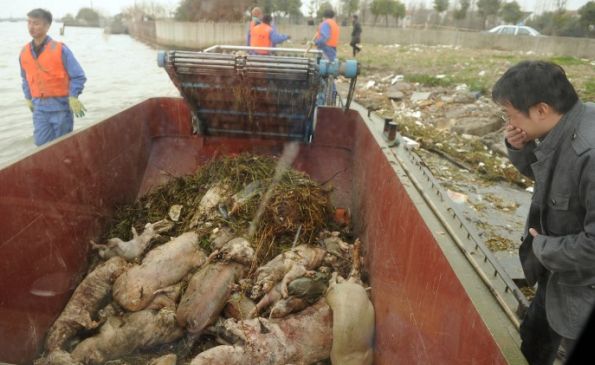
Well, this is patently disgusting:

Pigs, Pigs, Pigs!


Apologies to those who were eating while reading this post (or, you know, were ever planning on eating or drinking ever again).  Alas, it's better to face the truth head on rather than avoid it: there are dead pigs in the Huangpu River, which not only meanders through downtown Shanghai, creating the coastline that forms the famous Bund, but also provides for the vast preponderance of Shanghai's water supply.  Now, it's not like any of us were drinking the water to begin with.  It's gross, and even the natives don't really mess around with the water too much if they can avoid it.  But it does make you wonder about, say, cooking food with the water.  My roommate, Serge, uses bottled water to cook with, which always made me raise my eyebrows in environmental sanctimony.  He used to work in the clean water industry, and isn't shy about citing the arsenic content in Shanghai's water, which never actually evaporates, even when the water is boiled (Dad, if you're reading this, please don't fret.  You will survive your trip to China.  I promise.).  I've always been happy to use the tap water when I cook (arsenic, shmarsenic, I always say!), but now....well, I dunno.  The government, bless them, says the water is safe again, now that 6,000 of Porky's cousins were fished (pigged?) out of the Huangpu over the past few days.  I'm not sure I buy it.

I must admit that I'm not sure which is more disturbing -- the fact that the Huangpu is hogtied with pig carcasses, or my reaction to hearing of the news.  I was pretty unmoved by it.  I believe my first response was "Oh.  Well, that probably shouldn't be the case."  But it certainly wasn't surprise.  Or outrage.  It was more like, "Yup.  That sure sounds like China!"  In just over six months of living here, I've already become quite desensitized to the seemingly endless parade of "China is gross" examples.  It just doesn't make me raise my eyebrows anymore.  And part of the reason why is because I know I won't be living here permanently.  Tolerating things like swine in the drinking water is just something I'm trading in exchange for an adventure -- not something I have to live with forever.

This is kind of a problem, isn't it?  China is acutely aware of and concerned by the slowing down of its economy.  While the absurd levels of growth that it enjoyed for the last decade or so certainly weren't sustainable in the long run, the maintenance of world-power status is priority number one for the newly inducted regime in Beijing.  But I'm not so sure the economy is the biggest issue that China must address.  Rather, I wonder whether it's more about maintaining the country's appeal to the rest of the world.

China can make it as hard for its own citizens to leave as it wants.  But as long as expats view the country as merely a temporary stomping grounds to have some fun, make some money, and wait out the economic troubles in the West, China's position as a major player in the world stage is at risk.  And as it stands, there are serious environmental and lifestyle barriers that predispose foreigners to write China off as unworthy of planting firm roots.  There are exceptions, to be sure.  My friend Tom, the Horde's guitarist, has been living here for over 5 years, has a Chinese girlfriend with whom he lives, and has no plans of leaving any time soon.  But when we were discussing the pigs-in-the-river kerfuffle this morning, his response was, "Yeah, I just assume I'm going to die from a really awful form of cancer at some point" thanks to living here for so long.

China can't really afford to cultivate that sort of outlook in its foreign residents.  I met a middle-aged teacher last month named Sean, who loves China.  He's been living here for 12 years, before Shanghai was Shanghai, back when there were only 3 Metro lines (there are 16 now) and Western food was very hard to come by.  He doesn't really travel abroad -- he spends the bulk of his free time exploring China itself, making his way through the endless countryside, villages, and "small" towns.  He has no interest in leaving.  But he has a five year old daughter now, who he was content raising in Shanghai until the pollution became too much of an issue for him to ignore.  The notion of his child growing up breathing air that equates to smoking a pack of cigarettes a day is too bitter a pill for him to swallow.  After seeing two colleagues die of esophageal cancer, which he says is the most prevalent form of cancer in China, Sean is moving his family to Moscow at the end of the school year.  "You think I want to go to fucking Moscow?!" I recall him shrieking at me.  But go he must, after building what he had assumed was a permanent home in China.

The River of Pigs incident will, surely, soon yield to another aspect of life in China that is abhorrent to Western temperaments.  And people like me, and Sean, and Tom will probably just shrug our shoulders and say "That's China for ya."  Until the proverbial "that" is no longer "China for you", China will have a hard time holding onto its already-tenuous position as a serious actor on the global stage.

Monday, March 4, 2013

Women's Day

This Friday is national Women's Day in China.  All women get a federally mandated half-day off from work. What the fuck?

Sunday, March 3, 2013

The Release Party

When I look back, ten or twenty years from now, on my time living in China, I'll likely have retained various long-term memories about my experience abroad, grappling with the culture and language, the eclectic assortment of people I met, and the infinitely enticing travel opportunities of which I was able to take advantage.  These larger thematic memories tend to stick, with specific, singular, watershed events sprinkled throughout our recollection of yesteryear, in decreasing quantity as they fade away over time.  This Friday night was, I think, one such watershed moment.  It was The Horde's debut album release party at 390 Bar in Shanghai.  At the risk of hyperbole and cliche (that disclaimer should accompany this entire post, now that I think about it), it was an evening I will not soon, if ever, forget.

Since "officially" becoming the manager of the band at the beginning of 2013, I've developed a profound sense of ownership of my role in our little musical family.  Even though my managerial title is sort of silly -- my Rolodex of contacts in the musical scene here in China isn't nearly full enough to really call myself a "manager", though that is starting to change -- I do think the guys genuinely appreciate my unbridled enthusiasm for the music along with my eagerness to help with the logistic and financial side of the operation.  I have, from the very beginning, felt like a welcome member of the team.  Recently, I've even started saying "my band" or "we" when referring to the Horde's various conquests and exploits.

At the same time, the Horde has been around for a while -- three years, to be exact.  They've written over thirty original songs, and have performed them at various venues around Shanghai, the surrounding suburbs, Beijing, and even Mongolia.  They've been in the process of recording several EP projects for over a year.  The vast majority of their oeuvre and success was founded long before I came onto the scene.  Because of this, I've been eager to assume as much responsibility for the band's present activities as I can, particularly considering I won't be living here forever.

I therefore inserted myself directly helping to produce and releasing of "Considering Yourselves Conquered," the Horde's first studio album.  This process, which took over a year of recording, mixing, and mastering (none of which I was around for), as well as the designing and printing of the album copies themselves (which I negotiated with a production company in Shenzhen), culminated in an album release show this Friday night.

The week leading up to the show was marked with palpable twinges of anxiety and self-consciousness on the part of the band.  We had 1,000 album copies printed - when they arrived, and we all realized what 1,000 CD cases actually looks like, we were blown away.  There was no way we would ever be able to sell (or even give away) all of them!  We had decided to eschew an opening band at our show -- most music gigs in Shanghai of this ilk have at least two, if not several bands -- so that we could have time to play 3 full sets ourselves.  Were people really going to show up for over 2 hours of Horde music, without any other bands?  We had set the ticket price at 50 RMB (about $8.50), which is on the high end for this type of show, and even though we were throwing in a free copy of the album, the guys convinced themselves (and me) that the price would deter people from coming.  Even though all of us had gotten the word out to friends and various event websites, and had a lot of good press leading up to the show (interviews and music reviews), all of us, I think, arrived at the bar for sound check on Friday night with a slight sense of impending doom.  Images of an audience of only 10 people, half of them significant others of the band whose attendance was required by relationship laws, flitted through our minds.  The Horde has played sparsely attended shows before, and it didn't matter.  But for the album release party?  We wanted it to be epic.

And it was.  The pre-show jitters were entirely unwarranted.  Before they played a single song, the bar was abuzz with congratulatory hugs and anticipatory cheer.  Dozens of people flowed in, most of them friends and colleagues, but more than a few new faces as well.  And when I stepped on stage to introduce the band (the manager agreed to say a few words as the manager to kick off the show), people actually left the bar area and crowded the stage and dance floor to listen.


Halfway through the first set, Tom, the guitarist, broke two of his strings.  This happens to him literally all the time (something we give him a lot of shit for...he brings a whole knew meaning to the term "shredding a guitar"), so he was prepared with spare strings.  But it necessitated a fifteen minute lull in the show, risking the amazing energy that had been pumping through the room since the first song.  But the audience didn't budge.  Some got drinks, some made conversation, but all  of them just waiting for the band to start playing again.  We had expected people to leave after the first set, to carry on with their nights elsewhere rather than spend the entire night in one place.  Nobody left.  By the end of the show, some three hours later (that only felt like 45 minutes), you got the feeling that the crowd would've stayed for at least another hour.


All told, over 250 people came to the show on Friday.  The proceeds from the ticket price paid for the entire cost of the album printing...twice (we had hoped to just break even).  But far more important than the money (even to me, the Suit) was the euphoria that dominated the room for the entire night.  The Horde's music -- a combination of folk and bluegrass -- is incredibly easy to listen to.  It is happy, and optimistic, and fun -- proven on Friday night by the dozens of people who came primarily just to show support, and who ended up toe-tapping and head bobbing throughout the performance.  Normally, I take a lot of pictures a

For the five Horde members -- only one of whom, Nick, is a full-time musician (he plays for several other bands, and only occasionally with us) -- it was a night celebrating three years of playing music together.  None of them has earned any money for their efforts.  All proceeds from shows in the past have gone towards band-related endeavors, as will the roughly $2,000 we made on Friday night.  They do it because they genuinely love it, and that is apparent in their music.

For me, it was a humbling reminder of the pride that comes from seeing friends succeed, and have hard work pay off.  It offered sobering evidence of how lucky I am to be bouncing around the world, living in a place where strangers become close friends in literally seconds, and how a guy with virtually no business or music experience can become the manager of a bona fide band of talented musicians in less than six months.  There's a very good chance I won't be here in another six months.  Shanghai was never a long-term solution; it was always just part of the ride.  There are times, Friday night being one of the more powerful, when I'm just floored by the whole thing.  I'll look back at the release party at 390 one day, and not be able to remember how I ended up there.  But be pretty darn happy that I did.


Franco and Tom (from left to right) in the foreground.  Johnny, sitting on the cajon drum between them, and Nick on the accordion to the left.  Not pictured is George, standing to the right of Tom, wailing away on his harmonica.


For those interested, the album is available (for free) online here (I'm listed in the thank you section, as "Pajama Josh.")

Monday, February 25, 2013

BurgerWeekly Post: Smile Burger in Kyoto, Japan

In keeping with tradition, here's a copy of my contribution to BurgerWeekly on Smile Burger, a hole-in-the-wall burger shack to which I spontaneously offered my patronage in the middle of a sunny, long walk in Kyoto last week.

The original post can be found here: Smile Burger!

Also, burger lovers in NYC should consider going to BurgerWeekly's "Burgerversary 100" party at Blue Smoke in April.  Were I not 12,000 miles away, I'd surely be in attendance.  Burgerversary!

signBurger Ordered: Smile Burger
The Experience: A hearty 新年快乐 (xin nian kuai le – Happy New Year!) to all of the Little Meisters out there who celebrate the Chinese New Year. After partaking in the New Year’s revelry (which lasts more than a week) for a few days, Burgermeister Josh escaped the firecracker-bombarded streets for the much more tranquil confines of Japan. Thoughts of juicy burgers had taken a temporary backseat to temples and tempura.  Until, that is, Josh stumbled upon Smile Burger, a little hole-in-the-wall nestled comfortably amongst the storefronts of a busy thoroughfare in downtown Kyoto. Despite the early hour (it was barely 11 AM), and the fact that hamburgers aren’t exactly on the top of the list of local foods to sample while in Japan, Josh decided to honor his title as Burgermeister and give Smile Burger a try.
smileCollage
The dulcet tones of Avril Lavigne greeted the Burgermeister as he walked into the one room shop, not exactly the artist he expected to hear during his vacation in Japan. The place was tiny, as most establishments are in the Land of the Rising Sun, with only three tables and a take-out counter, behind which the lone proprietor – a young and cheerful Japanese guy – does his burger-flippin’ magic.
The Taste: Burgermeister Josh was initially tempted by the picture of Smile’s “Q Burger”, which appeared to be a quintuple-patty burger stack. However, discretion being the better part of valor (and hoping to save room for more traditional Japanese fare later), he settled on the classic Smile Burger. Josh had walked in hoping that the patty would be made with Kobe beef (this was Japan, after all), but was disappointed, if not unsurprised, to see that it was 100% Australian ground beef, seasoned in salt, pepper, and nutmeg. What the burger lacked in adornments (only lettuce and tomato), it more than made up for in condiments (ketchup, honey mustard, and Thousand Island dressing, all of which were already applied to the burger when it was served). A small portion of pickles and potato chips were served with the Smile Burger, which was presented rather nicely on a wooden board.
burgera
Despite somewhat low expectations, Burgermeister Josh was more than a little impressed with the Smile Burger! His initial doubts about the over-saucing of the burger were proven unwarranted, as the Thousand Island and honey mustard combined to create a tart relish flavor, with the ketchup providing its standard tomatoey sweetness. Not to be outdone by the sauces, the sweetness heartiness of the patty itself was readily apparent, the nutmeg in particular emerging in each bite. Josh doesn’t subscribe to the purist notion that burgers should be unadorned with seasoning lest they taste more like meatloaf. The Smile Burger was distinctly sweet and nutmeggy, and, Josh thought, all the better for it.
The Verdict: The Smile Burger had its shortcomings. The meat was slightly overcooked for the Burgermeister’s liking, which he was able to chalk up to his inability to convey his temperature preferences in Japanese. It was also quite greasy, though a burger of all things can be forgiven for a little grease. The pickles and chips that accompanied burger were by no means offensive, but Josh has always been of the opinion that French fries are the only suitable sidekick to a hamburger. These small demerits were not, however, nearly enough to dislodge Josh’s high perception of the Smile Burger. Overall, it was a tastier, more satisfying burger than any of Josh’s middling burger experiences in Shanghai. Shanghai may have glitz and glamour going for it, but, at least with this minimal sample size, Kyoto may indeed have the better of the burger scene!

Smile Burger is located on Higashi Oji Dori Street in Kyoto, Japan.

Saturday, February 23, 2013

Japan Part III: The Food

It was a dark and stormy night.

Okay - that's certainly a bit cliched and dramatic.  But it was dark (what kind of night isn't?), and it was raining.  It was also cold, and there wasn't a sole to be found on the streets of Okayama.  It was my first night in Japan.  I had taken the train up from Takamatsu, where I had landed that afternoon.  Okayama wasn't my final port of call, nor was it the city I was most excited to visit.  But it was my first night in Japan, dammit, and I was going to see what Okayama had to offer in terms of food, drink, and other excitement.  The answer was quickly discernable: not very much.

The streets of Okayama were cold, rainy, and, most perceptibly, empty.  One of the main drags, through the middle of a which flows a rather nice canal, was as quiet as a snowy mountainside in midwinter.  One could imagine it being a nice place for a stroll, but on this particular night it was just a cold place for a stroll, with very few, if any, enticing places for sustenance.

My exuberant traveling spirit somewhat dampened, I eventually turned back towards my hotel, hoping against hope that I would find somewhere - anywhere - to grab a quick dinner.  All thoughts of an authentic, amazing Japanese culinary experience had yielded to the desire for two things: food, and warmth -- perhaps not in that order, but as quickly as possible.

I ducked into what I hoped was a restaurant, and found myself in a small room, with just a countertop bar, and (of course) nobody in it.  An older woman was futzing about in the kitchen preparing food for the evening's patrons (why she needed to prepare was beyond me, given the lack of street traffic).  She came out and smiled, gestured me into a chair at the bar, and said in Japanese what must've been "What would you like?"

I looked around, decided that there was no way she would have an English menu, so I just shrugged my shoulders in an attempt to convey that I was indeed hungry, but didn't know how to describe what I would like to eat and also didn't care that much as long as it was hot.  In China, this probably wouldn't have worked.  Miraculously, however, she nodded, smiled again, and glided back into the kitchen from where I soon heard the sizzling of food being prepared.  She came out with some tempura style somethings (not meat, perhaps potato or some other root vegetable, I'm not really sure).  I managed to reason out the Japanese for "hot sake", which she gladly poured for me, along with a beer for herself.  And I started to eat.

The tempura was followed by some soup called oden, with all sorts of fun vegetables and meat inside it.  After that, she fried up some yakisoba noodles, prepared on the hibachi grill with soy sauce, cabbage, carrots, and other veggies.  Each "course" was filling enough (and delicious enough) to satiate my appetite, but after each I made the "mistake" of clearing my plate (I couldn't help it), which signaled to her that I wanted more.

That was my introduction to both food and hospitality in Japan.  That one meal changed my entire perspective on the trip -- I'm sure I would've come around anyway, after a good night's sleep in Okayama and a train ride (everyone knows how trains can cure any depression for me) up to Osaka the next day.  But her willingness to just cook for me, without being able to ask what I wanted to eat, made all the difference for a cold, tired traveler on a rainy night in Okayama.  Throughout the meal, she sat with me, sipping her lager as I nursed my sake.  She tried to make small talk, but most of the time we were both content just to sit, understanding that we couldn't really communicate with each other effectively.

That was, as they say, the tip of the iceberg.  From Okayama I went to Osaka, where I embarked on a mission for okinomiyaki, an Osaka speciality sometimes known as Japanese pizza.  The joint I had been directed to by the New York Times travel section had been, to my chagrine, torn down.  But I quickly found another buzzing "pizza" hut, frying up delectable and large saucers of cabbage, potato, egg, veggies, pork, some barbecue style mayo sauce, and crunch fish flakes.  It was, hands down, the best thing I had in Japan (along with the other, much cheaper, okinomiyaki I found in Nara a few days later).


Other culinary highlights included the Nishiki Food Market in Kyoto - a long, narrow open market full of fish vendors, tofu donut makers, and other oddities that I couldn't even figure out.  I sampled some "street sashimi", several yummy nuggets of raw tuna marinated in two different ways.  This was, surprisingly, the only raw fish I ate in Japan.  I perhaps naively assumed that sushi was more ubiquitous in Japan than it was elsewhere, but it's just as much of a delicacy there (if not more so) than it is in the US.  So unless you're prepared to fork over a large wad of yen, sushi is probably not the ideal meal, even in Japan.


I went to Honke Owariya, a noodle house in Kyoto that has existed since 1465.  The cold soba noodles were served in 5 small bowls, stacked on top of each other, along with a dish of eight or so "toppings" including egg, shitake mushroom, spring onion, and shrimp tempura, with which one could make five little "make your own" noodle plates.


These are takoyaki, balls of dough and octopus in a tangy sauce.  They didn't appeal to me at first, but after trying them at a mom and pop shop in Nara, I can say I'm a fan.


Some gyoza and ramen near the train station in Takamatsu.  Sprinkled in between were random restaurants stumbled upon in the same ilk as the first one in Okayama, as well as a dinner of fried meat and veggies (delish, but heavy) with a Japanese friend of a guy I met at the hostel I stayed in Kyoto.  All in all, the food was terrific, if not initially a bit difficult to find.


Wednesday, February 20, 2013

Japan Part II: Kyoto

While planning my trip to Japan, I quickly faced the realization that I wasn't going to make it to Tokyo.  The global airline conspiracy that I'm convinced exists obviously monitors national holidays, and so even though I had the foresight to book in early November, some four months in advance, flights to the Japanese capital were already way more expensive than normal.  So I compromised, knowing I wanted to get to Japan and not really caring if that didn't include Tokyo, and booked a low-cost airline flight to a city of which I had never heard: Takamatsu.

It didn't take long scouring the Internet to realize that I wasn't going to spend five days in Takamatsu.  There appeared to be very little there other than a nice view of the water (the few hours I did end up staying there confirmed this).  So the question became how to efficiently budget my time so that I could see as much as possible, and still make it back to Takamatsu on Sunday to catch my flight back to Shanghai.  Several possibilities were within shooting distance: Matsuyama and Hiroshima to the west, Okayama, Himeji, Kobe, Osaka, and Kyoto to the east.  I decided that my primary destination would be Kyoto, for its history and foretold physical beauty, and while I would try to hit as much as I could on the way to and from the old capital, I would make it my primary stomping grounds for the trip.

Boy was I glad that I did.

Kyoto is a city of two temporal mindsets; a capital steeped in imperial history without refusing to usher in the hustle and bustle of a modern urban environment.  The countless temples, shrines, and palaces are scattered throughout the city, and are surrounded by the modern city, which in and of itself is quite lovely.  It has virtually none of the steel splendor for which Tokyo is known; aside from the Kyoto Tower, which looks like a miniature version of Seattle's Space Needle, I don't think any building eclipses 20 stories in height.  This provides for stunning views from high ground, of which there is plenty in the mountains that form a bowl in which Kyoto is nestles, of the low-rise cityscape.

I saw a sign on my first day there that declared Kyoto to be "The Walking City."  So walk I did, weaving my way in and out of the narrow alleyways, mountain paths, and myriad temples.  The tourist map of the city that my hostel gave me was initially quite daunting - there was no way I was going to see everything in just two and a half days.  So I just walked, and saw as much as I could.

Unlike some of the ancient capitals in the West (think Rome and Athens), much of Japan's historical treasures have been restored and rebuilt, either because they burned down (everything in Japan is made of wood) or because of the focus paid to maintaining the true essence of the building.  This struck me as an interesting contrast from the way we traditionally treat historical artifacts in the western world, where we seem to be impressed only by how old something is, and how little it has been interfered with.  History, in Japan, is preserved through restoration and constant upkeep -- the tour guide at the Imperial Palace noted that the palace's maintenance, which is purely for symbolic value, costs Japanese taxpayers millions of yen every year.  She said that each of the buildings have their roofs completely redone every 30 years, which requires so much cedar tree wood that it takes 25 years to gather enough. Restoration and reconstruction, according to the strict guidelines of how it would have been built in the past, was a refrain I heard at virtually every historic site I visited in Japan.

One of the refreshing things about Kyoto is that it didn't seem at all repetitive, as I thought it may have been.  Each site had its own character and history, and even if I couldn't understand all of the Japanese descriptions on the various displays, I felt like I saw something different each time.  From the Imperial Palace in the center of the city, to the Golden Pavillion, to the Inari Shrine, to the Kiyomizu-dera Temple, to the Nishiki Food Market, to the Kyoto Museum, to the International Museum of Manga, to the various restaurants and bars I went to -- I don't think I was disappointed by a single thing I did in Kyoto.


Kiyomizu-dera Temple, which offered great views of the city and cool architecture.


The Imperial Palace in Kyoto is governed by the Imperial Housing Office, which regulates visitors to the old residence of the Emperor.  At 10AM and 2PM every day, foreigners can show up and take a tour, which I did.  The palace itself has been stripped of its furniture (when the Emperor visits Kyoto, he stays in a different palace nearby), so the tour only consists of the grounds, which were cool in and of themselves.


The garden inside the Imperial Palace.  Pretty nice for a backyard.


Japanese cities tend to form a grid of wide boulevards connected by narrow streets and alleyways.  I thought this street was particularly cool because of the mountains in the background.  The picture also ended up having a bit of "Abbey Road" feel to it as well.


The distinctly modern looking Kyoto Train Station.  The stations in both Kyoto and Osaka seemed to serve both as transportation hubs and entertainment centers.  A very small percentage of this huge building is used for the actual trains -- the rest is restaurants and shopping malls, which buzz with people until the trains stop running at midnight.


Across the street from Kyoto Station is the aforementioned Kyoto Tower.  I didn't make the ascent, mostly due to lack of time, but also because I felt like I had seen Kyoto from above already, thanks to the various climbs I made at the shrines and temples.


The Kinkaku-ji, or Temple of the Golden Pavilion.  Wrapped in gold foil, the temple is easy fodder for picture seekers, especially when you add in the water's reflection.


One of the highlights of the entire trip was the Inari Shrine: a 90 minute hike up a mountain past a dozen or so little shrines and altars, with literally thousands of orange gates lining the path.


The view from halfway up the Inari Shrine.  Perhaps the only disappointment was that there wasn't much of a vista at the top of the hill, due to tree cover, so I had to settle for this view at the midpoint of the hike.